Whale safari from Tromsø: the orca are off Skjervøy, and the day is 10 hours long
The herring moved north after 2017 and the whales followed. How a winter whale day from Tromsø actually works: bus or boat to Skjervøy, the 50 metre rule, prices for 2026/27, and what minus 10°C on an open deck does to you.
Winter whale safaris from Tromsø all go to Skjervøy, where orca and humpbacks feed on herring. Season dates, bus and boat options, 2026/27 prices, sighting odds, rules on the water and the fallback.
The orca and humpback whales are not off Tromsø. They feed off Skjervøy, 4.5 hours north by bus, where Norwegian spring-spawning herring now overwinter in Kvænangen. A whale safari (hvalsafari) from Tromsø is an 8 to 10 hour day on a catamaran, or a 12 hour day with a bus each way and a RIB in the middle. Boat days from Tromsø cost 1,845 to 1,990 NOK per adult, checked 11 October 2026. The season opens in October and closes on 31 January; November to early January is the window that pays. Nobody can guarantee a whale. Brim Explorer reports whales on 95% of departures last season. The sea state cancels more days than the whales do.
The reality check
From the winter of 2011 to 2012 the herring overwintered in Kaldfjorden and the fjords around Kvaløya, 20 minutes from the city. Fram Centre researchers estimated 400 to 600 humpback whales per season there, some staying 4 to 6 weeks and eating 20,000 to 25,000 tonnes of herring between them. After six straight winters, no large schools came in late 2017. The herring moved north towards Lyngenfjord and Kvænangen, and the whales followed.
Second reality: the whale area is crowded. Between 23 October 2025 and 15 January 2026, observers commissioned by Visit Tromsø-Region and four operators logged 9 to 14 boats around single whale groups west of Skjervøy, once 23. Eight of ten boats sat under 100 metres from the whales, six of ten under 50. The whales changed direction, dived longer and stopped feeding. Those companies have asked the government for licensing, speed limits and a snorkelling ban. Until that arrives, the operator you choose is the only regulation that reaches the water.
The rules on the water
Norway adopted a whale-watching regulation in December 2019 (Forskrift om utøvelse av hvalsafari), enforced by Fiskeridirektoratet, the Directorate of Fisheries. Its objective is whale watching that is "safe, sustainable and considerate". The numbers that matter on deck come from the voluntary Tromsø guidelines, written in 2017 by cetacean researchers at UiT and the Tethys Research Institute:
| Distance | Rule |
|---|---|
| Within 300 m | Under 5 knots, from the side and slightly behind |
| From 100 m | Minimum speed |
| From 50 m | Idle. Engine to neutral if whales approach |
| Boats per group | Maximum 3; waiting boats hold 500 m off |
| Time per boat | Maximum 30 minutes |
| In the water | No swimming or diving with whales |
Ask the operator which of these they follow before you pay. A shrug is an answer.
The survival layer
Thermal flotation suits come with the RIB and small-boat trips from Skjervøy. The catamarans from Tromsø give you a heated saloon; you dress yourself. Leave cotton in the hotel. Wool base layer, wool or fleece mid-layer, insulated jacket, windproof shell. A wool hat over the ears, mittens over liner gloves, insulated boots with room for thick socks, a buff for the face. Every knot of boat speed is 1.85 km/h of wind across the deck: at 20 knots in still air you stand in a 37 km/h wind at minus 10°C. Go inside every 20 minutes. The full list is in the Arctic packing guide.
Brim Explorer's own listing warns that "conditions at sea may be rough" on the Tromsø to Skjervøy run. Buy motion-sickness tablets at any apotek (pharmacy) in Tromsø and take them before boarding, as the packet says, not when the first wave hits. Eat breakfast, stay on deck and watch the horizon. The warm saloon is the worst place to be once it starts.
The logistics
Prices per adult in NOK, checked 11 October 2026 on the operator or Visit Tromsø listing.
| Option | Departs | Duration | Price (11 Oct 2026) | Operator and vessel |
|---|---|---|---|---|
| Hybrid-electric boat from Tromsø | Kaigata 6, 07:30 to 09:00 | 8 to 9 h, back 17:00 to 17:30 | 1,990 (2,189 from 11 Dec to 10 Jan); child 995 | Brim Explorer, MS Brisen (25.3 m) or MS Bard, max 135. 1 Oct 2026 to 31 Jan 2027 |
| Diesel catamaran from Tromsø | Kaigata 6, 08:30 | About 8 h, back 16:30 | 1,890; child 945 | Brim Explorer, MS Fjordjarl, 39 m, max 250. 1 Nov 2026 to 31 Jan 2027 |
| Catamaran from Tromsø with Whale Pass | Vervet, Skansegata 7, 08:30 | About 8 h | 1,845; child 878 | Arctic Whale Tours, MS Alba. November to January |
| Bus one way, boat the other | Prostneset, 07:30 | 8 to 9 h; 1.5 h with whales | 1,990; youth 1,493; child 995 | Brim Explorer, MS Bre hybrid-electric. November to end of January |
| Arctic Route bus plus RIB from Skjervøy | Bus 05:30 Prostneset, Skjervøy 09:25. RIB 09:30, Strandveien 70 | Bus 4.5 h each way, RIB 3 h. Tromsø 17:20 | Bus 890 each way. RIB 1,890; child 945 | Best Arctic bus, 17 Oct to 31 Jan. Explore 70 Degrees RIB, max 12, suit included, minimum age 6 |
Dervola Adventure runs a 27 foot Arvor 810 from Skjervøy at 10:00, daily November to January, suit included; its listing publishes no price. The Svipper express boat (hurtigbåt, passengers only) takes about 2 hours, the public bus about 5 with the Lyngenfjord ferry; neither is timed to a 09:30 safari. Driving takes around 3 hours with the Lyngen ferries, about an hour more by road without them, and the return is in the dark.
The forecasting tool
Wind and darkness ruin whale days. Check both the night before.
- Wind. Pull up Skjervøy and Kvænangen on yr.no and read the gust figure, not the mean. BarentsWatch publishes a wave forecast for exposed stretches of the coast. RIBs stay in harbour first; the operator decides on the morning.
- Light. The sun stays below the horizon in Tromsø from the end of November to the middle of January; Skjervøy is further north. Clear days give midday twilight; trips run inside it. Bring a camera that shoots at 1/1000 s and a lens of 200 mm or longer; at the 50 metre idle line, a phone gives you a dot.
- Sightings. Brim Explorer's season log says it sees whales "nearly every tour" and that success drops in late January. Read the last 7 days of an operator's posts, not the season claim.
The timing truth
Brim Explorer's hybrid-electric tour sells from 1 October 2026 to 31 January 2027; the Arctic Route bus runs 17 October to 31 January. Brim's blog records the first whales of 2025 on 2 October, calls November to early January "statistically the best time", and notes that sightings decline "in late January". The Fram Centre study of the Kaldfjord years found herring biomass peaked in mid-December. Early October is a bet on arrival, mid-November to 10 January is the window, late January a bet on departure. Brim's Christmas tariff of 2,189 NOK runs 11 December to 10 January, so the best weeks cost most and are darkest. See when to visit Norway and the budget guide.
The fallback plan
Put the whale day in the first half of your stay. Then:
- The sea cancels the boat. Brim Explorer reschedules or refunds in full when conditions are unsafe, and its Visit Tromsø listing says the tour "may be changed to an Arctic Fjord Cruise". Arctic Whale Tours refunds or rebooks.
- No whales. Brim does not refund: "we are therefore not able to give money back if we do not see whales". Arctic Whale Tours issues a Whale Pass for one free rebooking in the same or following season. With one spare day, that matters more than 145 NOK.
- Bus and RIB booked separately. The Best Arctic bus runs whether the RIB does or not, and warns that "driving times can be extended and arrivals can be delayed". Book both legs from one operator.
- Use the day. The wind that cancels a boat does not cancel the sky. Check the KP index and go aurora hunting, or walk the Sherpa stairs above Tromsø. From the Lyngen side, a second attempt costs a morning, not a day.
Questions travellers ask
Can you see whales from Tromsø itself?
Not in winter 2026/27. The herring left Kaldfjorden after 2017 and the whales feed off Skjervøy and in Kvænangen, 2 to 3 hours away by boat. Every "Tromsø whale watching" ticket is a Skjervøy trip with a long transfer.
Orca or humpback: which will I see?
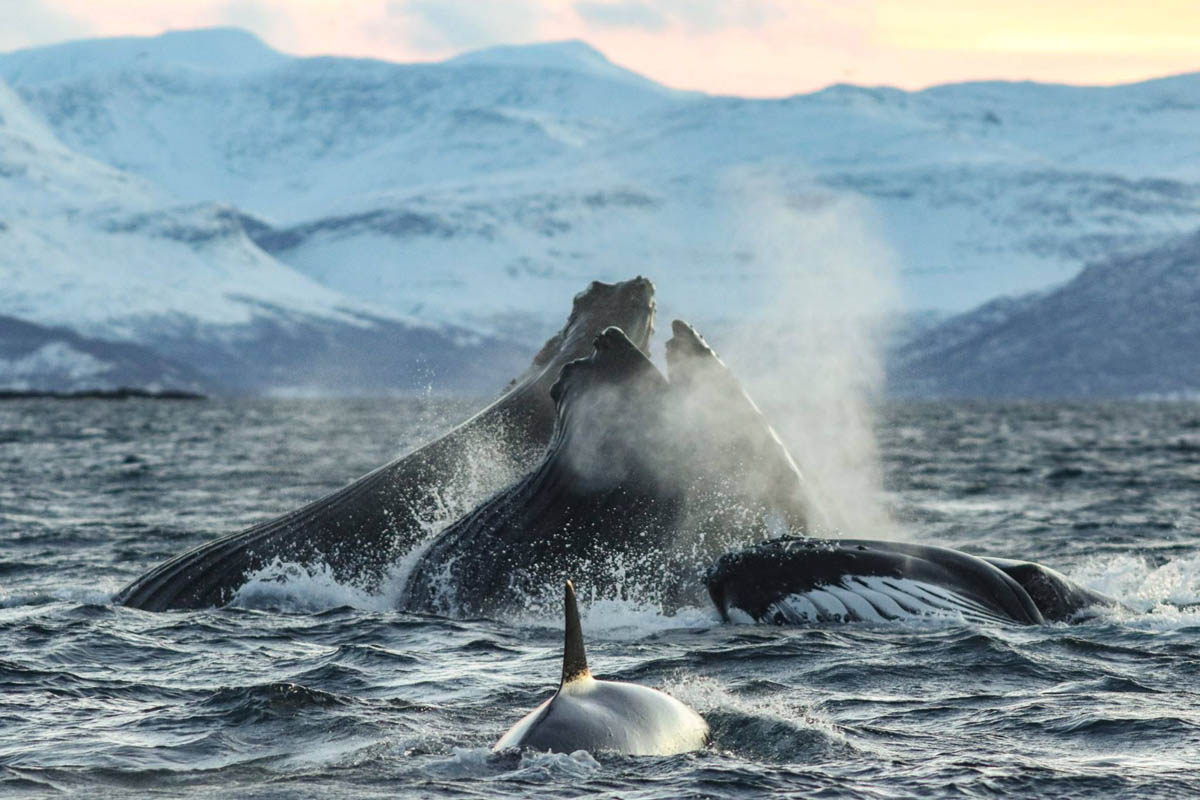
Both feed on the same herring, and fin whales turn up some seasons. Humpbacks lunge through the shoals and lift the fluke when they dive; orca travel in family groups and show a tall dorsal fin. No operator promises a species.
RIB or big boat?
The RIB (12 passengers, thermal suit, 3 hours) sits at water level and you feel every wave and every degree. The catamarans (135 to 250 passengers) have heated saloons, toilets and a café. RIB for proximity, catamaran for a 10 hour day you finish on your feet.
Do I need to book in advance?
Yes for December and the first ten days of January. RIBs carry 12, the bus has fixed seats, and Brim's Christmas tariff runs 11 December to 10 January. Book the whale day first, with a spare day behind it.
Bjørn Haugen is the Arctic Field Editor at NorgeTravel. DNT-certified guide (25+ years), Tromsø Røde Kors Hjelpekorps alumnus. He can be reached at hei@norgetravel.com.
Sources: Brim Explorer tour, ship and blog pages; Visit Tromsø operator listings, 2017 whale watching guidelines and 2025/26 press release; Visit Lyngenfjord listings; Best Arctic timetable; Fram Centre, "Herring impacts on north Norwegian fjord ecosystems"; Ecolex, Regulation No. 1651 on whale watching; Visit Norway polar night page; yr.no; BarentsWatch; Svipper. Checked 11 October 2026.
ノルウェー旅行のプランを立てる
無料のインタラクティブなトリッププランナーで、ノルウェーのルートを計画し、認証済みのエコフレンドリーな宿泊と交通を予約し、現地のフェリー時刻表を確認できます。
Up Next: Keep Exploring
RIBフィヨルドサファリ ゲーランゲルフィヨルド:クルーズ船では味わえない体験
RIBフィヨルドサファリなら、セブンシスターズの滝からわずか15メートルの距離まで時速35ノットで大接近。このツアーの魅力、惜しい点、そして895ノルウェークローネという料金が本当に妥当なのかを正直にレビューします。
セブンシスターズの滝の下でカヤック体験:ガイランゲルフィヨルドをパドルで4時間
ガイランゲルでのカヤックツアーでは、8名のパドラーがセブンシスターズの滝のすぐ下、切り立った崖の壁に手が届くほどの距離に。4時間、1,550ノルウェークローネ、ドライスーツ貸与。この体験で得られるものと、どんな人におすすめなのかを詳しくご紹介します。
車で巡るガイランゲル:鷲の道、フライダルスユーヴェ、ダルスニッバを一日で満喫
鷲の道は11のヘアピンカーブで620メートルの高さを駆け上がり、ダルスニッバ(標高1,476メートル)からはフィヨルドが細い青い線となって眼下に広がります。ツアーバスと駐車スペースを奪い合うことなく、これらすべてを一日でドライブする方法をご紹介します。